

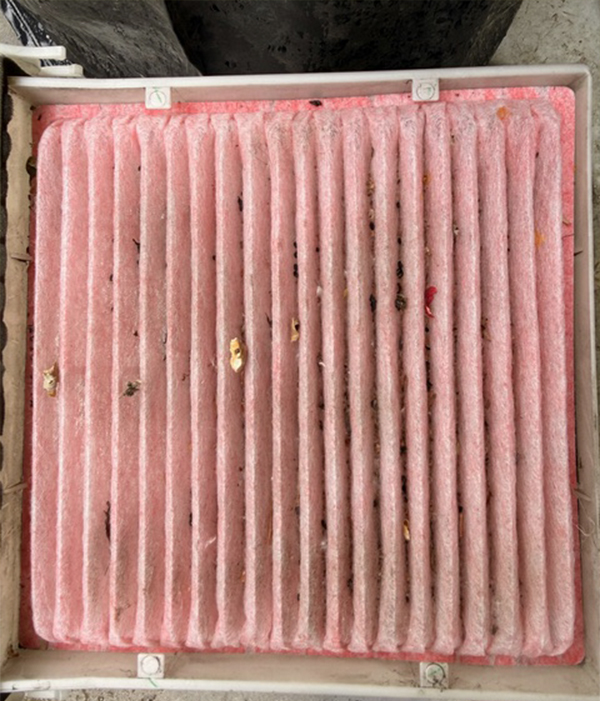
Then Kristi discovered something particularly disturbing.
There were nuts in her purse—or, more accurately, in her little fanny pack.
Okay.
Now we knew we had a visitor.
We just didn’t know who—or how many.
We started looking everywhere.
And the more we looked, the more evidence we found.
Something had apparently decided that YOLA wasn’t just a vehicle.
It was home.
There were signs of food being sampled, paper goods being shredded, crumbs appearing where crumbs definitely shouldn’t be, and nuts being relocated to places that made absolutely no sense to us.
Then we found something that looked suspiciously like the beginnings of a nest.
It was a small tangled bundle of fine fibers—mostly tan material that appeared to have been pulled from somewhere inside YOLA, mixed with a few little red threads.
Okay.
Now things were getting personal.
Our mysterious visitor wasn’t just eating our food.
It was apparently redecorating.
Our little overland home had apparently become a luxury rodent condominium.
But there was one concern that wasn’t nearly as funny.
The wiring.
We knew that rodents could potentially cause serious problems if they started chewing on electrical wires. And the thought of discovering a damaged wire somewhere under the hood was enough to make my stomach sink.
The last thing we needed was for our tiny hitchhiker to chew through something important, leave us stranded in the middle of nowhere, and turn our little adventure into a very expensive repair bill.
So I checked under the hood.
We inspected what we could.
Fortunately, we found no evidence that our little visitor—or visitors—had taken an interest in YOLA’s wiring.
That was a huge relief.
Because a shredded roll of toilet paper is one thing.
When we eventually arrived in Palmer, Alaska, we visited our friends Murph, Peggy, and their son Jerry.
Naturally, we told them about our mysterious stowaway.
Murph had a pretty good theory:
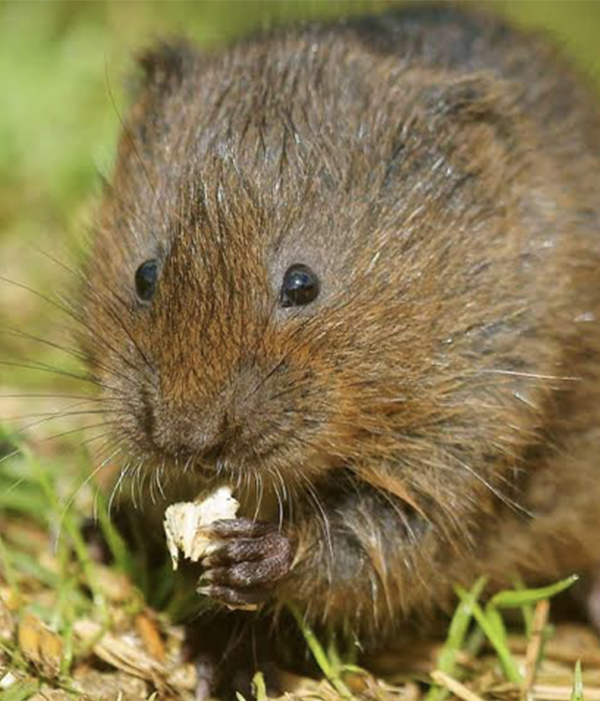
A vole.
Apparently, we may have picked up our tiny hitchhiker at one of the provincial parks in Canada.
Now we had a mission.
We needed to get the vole out of YOLA.
We decided the first thing to do was remove absolutely everything from the vehicle.
And I mean everything.
We emptied cupboards, cubbies, storage boxes, and every nook and cranny we could find.
We cleaned.
We vacuumed.
We inspected.
Then came the defensive strategy.
I did some research and read that peppermint sachets might discourage rodents, so we began strategically placing them throughout YOLA.
Then came the highly scented dryer sheets.
And finally, Murph suggested a couple of mouse traps with a little peanut butter.
We weren’t thrilled about that last part. We really wanted a humane solution.
But by this point, we were running out of ideas.
So YOLA became something of a science experiment.
Peppermint sachets everywhere.
Dryer sheets everywhere.
A couple of mouse traps strategically placed.
Every nook and cranny seemed to have something stuffed into it.
For the next couple of days, YOLA smelled absolutely fantastic.
Honestly, it probably smelled better than it ever had.
We waited.
And watched.
And waited some more.
We never found a mouse—or a vole—in the traps.
But something interesting happened.
No more turds.
No more crumbs.
No more shredded toilet paper.
No more mysterious nuts appearing in places where nuts had no business being.
The evidence had stopped.
We couldn’t say for certain whether our little visitor had left voluntarily, disliked our new peppermint-and-dryer-sheet décor, or simply decided the neighborhood wasn’t worth the trouble anymore.
But we were willing to declare victory.
Our little vole—or whatever our mysterious passenger actually was—taught us something we probably should have known from the beginning:
When you’re living on the road, everything needs to be sealed.
We learned that even food in its original packaging isn’t necessarily safe from a determined little critter.
We had left a couple of our Peak Performance dehydrated meals sitting around, and our tiny visitor had started chewing on those too.
Apparently, “factory sealed” doesn’t mean much when you’re a vole with time on its hands.
So we changed our system.
We purchased heavy-duty, snap-on plastic storage containers for our dry foods and other supplies. Now our dehydrated meals, snacks, and dry goods are securely stored inside them.
We also started putting toilet paper and other paper products into double zip-top bags.
Everything has a place.
Everything is sealed.
And everything that might smell remotely interesting to a hungry little creature gets locked away.
So far, the system has worked.
No more mysterious crumbs.
No more shredded paper.
No more nuts in Kristi’s fanny pack.
And, thankfully, no more tiny black surprises in the storage boxes.
Looking back, it’s actually pretty funny.
At the time, though?
Not quite so amusing.
It took a couple of days, a couple of brains, a couple of good friends, a little research, a whole lot of cleaning, peppermint sachets, dryer sheets, mouse traps, and one very persistent little vole—or perhaps an entire vole family—to teach us another important lesson about life on the road.
And maybe that’s one of the unexpected joys of this journey.
We set out thinking we’d be learning about different places, different cultures, roads, landscapes, and people.
But sometimes the road teaches you through something much smaller.
Like a vole.
A tiny creature that somehow found its way into our home on wheels, rearranged our belongings, shredded our toilet paper, sampled our food, left nuts in our stove—and, thankfully, decided that YOLA’s wiring wasn’t on the menu.
We’re still not entirely sure whether we evicted one vole or an entire family.
But we do know one thing:
At least for now.
And if we ever see another shredded roll of toilet paper…
we’re investigating immediately.
— John & Kristi